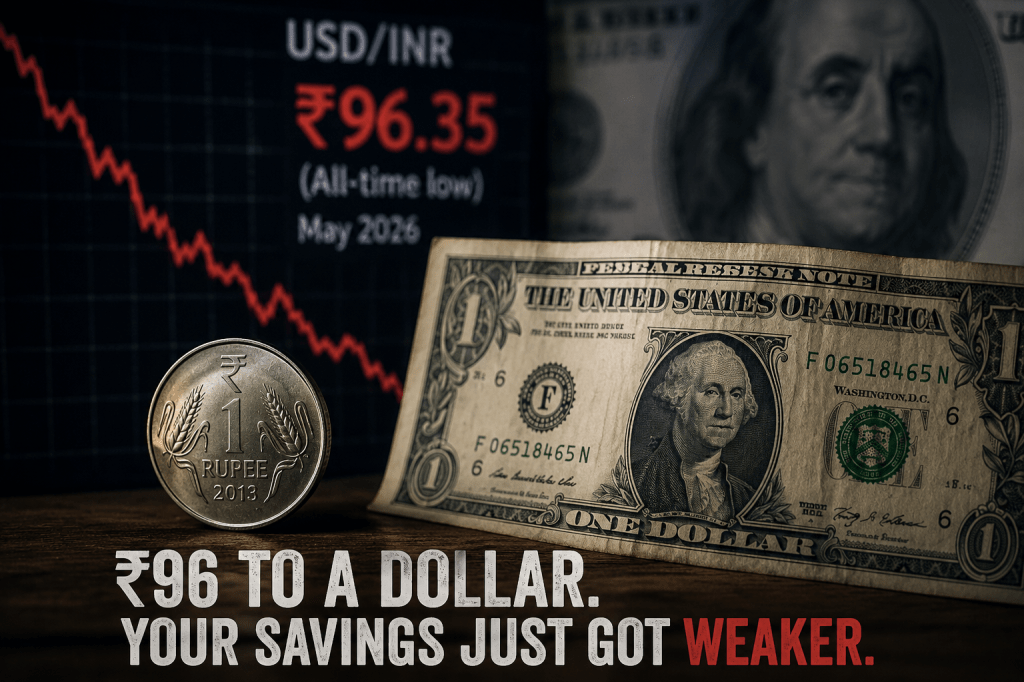
₹96 to a Dollar: Your Savings Account Is Not as Safe as You Think
₹96 to a dollar is not just bad news for importers. It is bad news for your savings.
If your money is sitting quietly in a bank account, the number may look stable. But the value behind that number is being cut down silently.
No alert. No warning. No visible loss.
That is the trap.
You think you are standing still. In reality, your purchasing power is moving backwards.
Your Rupees Just Got Weaker in the Real World
At ₹96 to a dollar, one simple thing happens: India needs more rupees to buy the same dollar priced goods.
This matters because India does not live in a rupee only world.
Crude oil is priced in dollars. Many imported goods are priced in dollars. Electronics, components, machinery, chemicals, fertilisers, shipping, global services, foreign education, travel, medical equipment, luxury goods and even parts of everyday supply chains are connected to the dollar in some way.
So when the rupee weakens, it is not some abstract number moving on a trader’s screen.
It affects the cost base of the economy.
And eventually, someone pays.
Usually, that someone is you.
Oil Is Where the Weak Rupee Hits Home
India imports most of its crude oil. Nearly 90 percent is a fair round number to understand the dependence.
That creates a simple problem.
If crude oil prices rise globally, India pays more dollars per barrel.
If the rupee weakens at the same time, India also needs more rupees to buy each dollar.
That is the double hit.
Let’s keep the example simple.
If oil costs $100 and the rupee is at ₹80, that barrel costs ₹8,000 before other costs.
If oil stays at $100 but the rupee moves to ₹96, the same barrel now costs ₹9,600.
Nothing changed in the barrel. Same oil. Same quantity. Same global price.
But for India, the cost rose because the rupee weakened.
Now imagine oil itself also rises from $100 to $110. Then the damage is not just currency. It is currency plus commodity inflation.
This is how imported inflation enters your life.
Not with a headline. With fuel. Transport. Food movement. Electricity inputs. Airline tickets. Logistics. Packaging. Delivery costs. Everything that moves starts costing more.
This Is Not a Shock. It Is the System Working
But zoom out.
The rupee has been losing value against the dollar for decades. Not every year. Not in a straight line. But directionally, the pattern is obvious.
This is not a freak accident of 2026.
It is the nature of fiat currency.
The RBI can intervene, use reserves, manage liquidity and slow disorderly moves. That does not change the larger truth. Even the institution defending the rupee is operating inside a fiat system. It cannot create real value. It can only manage the speed and smoothness of dilution.
Fiat money is not designed to hold purchasing power forever. It is designed to be managed, expanded, inflated, defended, adjusted and diluted. Sometimes slowly. Sometimes violently.
That is why every generation says the same thing:
“Things have become expensive.”
No. The things did not magically become expensive.
Your money became weaker.
The Bank Balance Lie
A savings account feels safe because the number does not fall.
If you deposit ₹10 lakh, tomorrow it still shows ₹10 lakh. That creates comfort.
But money has two values.
One is nominal value. That is the number printed on the screen.
The other is real value. That is what the money can actually buy.
The trap is that banks show you the nominal number. Life charges you the real number.
Let’s say your savings account gives you 3 percent a year.
Now assume your real cost of living rises by 8 percent. This is just an illustrative number. Your personal inflation could be lower or higher depending on your lifestyle, city, rent, medical costs, education costs and fuel usage.
On paper, you earned 3 percent.
In real life, you lost 5 percent of purchasing power.
That is how standing still makes you poorer.
You did not gamble. You did not make a bad investment. You did not lose money in the stock market.
You simply held currency.
And currency did what fiat currency does.
It diluted.
The ₹100 Illusion
Think of ₹100.
If ₹100 buys a basket of basic goods today, and next year the same basket costs ₹108, your ₹100 did not stay whole.
It became ₹92.59 in real terms.
Again, that is an illustrative calculation, not an official inflation number.
But the logic is real.
Inflation is not just rising prices. It is falling money.
And currency depreciation adds another layer. If the rupee weakens against the dollar, anything linked to global pricing becomes more expensive in rupee terms.
That is why the person sitting fully in cash can feel responsible, conservative and safe, while quietly losing ground every year.
This is the psychological genius of fiat debasement.
It does not look like theft.
It looks like normal life.
The System Rewards Borrowers and Bleeds Savers
In a fiat system, savers are told they are prudent.
Then the system quietly punishes them.
Why?
Because fiat economies are built on credit expansion, consumption and controlled inflation. Debt needs inflation. Governments need inflation. Large borrowers benefit from inflation because they repay old debt with weaker future money.
But savers?
They hold the currency being weakened.
Take a simple Indian example. Someone who took a home loan in 2010 and bought an asset may be repaying old debt today with rupees that are much weaker than the rupees they borrowed in. Meanwhile, someone who kept the same amount mostly in cash or low yielding deposits may have preserved the number, but not the buying power. These are illustrative comparisons, but the direction is the point.
That is the uncomfortable truth.
If you save only in money that can be expanded endlessly, your discipline becomes someone else’s liquidity.
The person who owns scarce assets watches prices rise.
The person who owns only rupees watches affordability fall.
Same country. Same economy. Different outcome.
Don’t Panic. Get Clear.
This is not a call to panic.
It is a call to stop sleeping.
The rupee at ₹96 does not mean tomorrow everything collapses. India will continue functioning. People will go to work. Markets will open. Salaries will be paid. EMI reminders will arrive on time.
That is exactly the point.
Currency debasement is rarely dramatic in daily life.
It is slow enough to ignore and powerful enough to ruin decades of savings if you never understand it.
One year, foreign education feels expensive.
Then imported phones feel expensive.
Then fuel feels expensive.
Then eating out feels expensive.
Then medical care feels expensive.
Then retirement feels impossible.
Everyone complains about prices. Few question the money.
Wealth Is Ownership, Not a Bigger Rupee Number
A rupee balance can be useful. You need liquidity. You need emergency money. You need cash flow.
But do not confuse liquidity with wealth.
Real wealth is not just money sitting in a bank account.
Real wealth is ownership.
Ownership of productive assets. Scarce assets. Skills. Businesses. Equity. Land. Intellectual property. Systems. Things that can hold or grow value while the currency underneath keeps weakening.
The exact mix is personal. This is not investment advice. It is a framework.
The question is not, “How much money do I have?”
The better question is, “How much of my net worth is sitting in something that can be silently debased?”
That question changes everything.
This Is the Part Most People Miss
The rupee hitting ₹96 is not just a forex event.
It is a reminder.
Your money is not fixed. Your savings are not automatically safe. Your bank balance is not the same as purchasing power.
The system rewards people who understand the difference.
Most people will look at the rupee chart and say, “The currency fell.”
But the sharper question is this:
If your money is losing value while you do nothing, are you really saving?
 Fiat to Free
Leave a comment