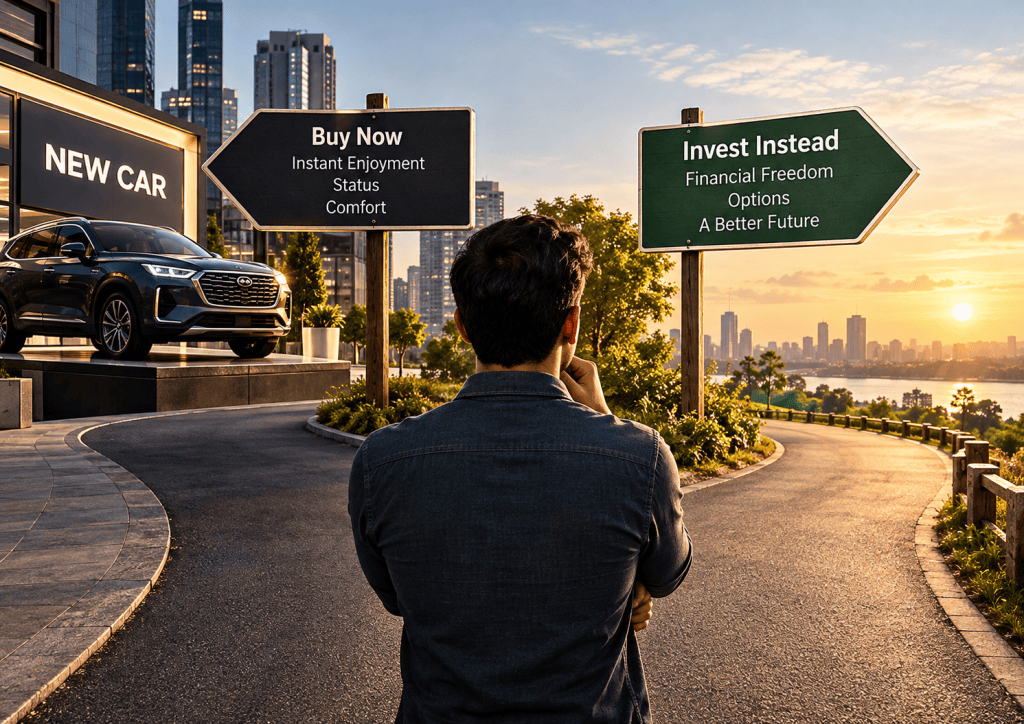
Every rupee you spend makes a decision about your future. The problem is that most people only see the decision they made, not the one they gave up.
A ₹15 lakh car doesn’t necessarily cost ₹15 lakh.
It could cost you a better home, an earlier retirement, a business you never started, or the financial breathing room you didn’t know you would need five years later.
Not because the car is a bad purchase.
Because money can only be spent once.
And every time you choose one thing, you quietly give up something else.
Economists have a name for this: Opportunity Cost.
It is one of the most important concepts in finance. Yet most people go through their entire financial lives without consciously applying it.
They know what something costs.
They rarely ask what it costs them to choose it.
The Price Tag Is Only Half the Story
Imagine two colleagues working in Mumbai.
Both earn roughly ₹1.5 lakh a month. Both receive a ₹6 lakh bonus.
One decides to upgrade his car. He already owns a perfectly functional vehicle, but a newer model feels appropriate for his income and position.
The other keeps his existing car and uses the money to strengthen his financial position.
Five years later, their lives may look very different.
Not necessarily because one invested brilliantly or the other made a terrible mistake.
But because they used the same ₹6 lakh to purchase two different futures.
The first bought a better driving experience, additional comfort and perhaps genuine enjoyment.
The second bought something less visible. Maybe lower debt, additional assets or the ability to handle an unexpected financial setback without borrowing.
Neither choice is automatically right.
The mistake is making the first choice without recognising the second.
That is opportunity cost.
The real cost of a decision includes the value of the best alternative you gave up.
And that cost never appears on the invoice.
Your Money Has an Invisible Second Price
Let’s put some numbers behind this.
Suppose you are choosing between two cars.
One costs ₹9 lakh. The other costs ₹15 lakh.
The difference is ₹6 lakh.
Now imagine that ₹6 lakh was available for long-term investment instead. At a hypothetical annual compounded return of 8%, it would grow to approximately ₹13 lakh over ten years, before taxes and inflation.
That is an illustration, not a promised return. Actual investments can perform better, worse or lose value.
But notice what happened.
The decision wasn’t simply whether to spend another ₹6 lakh today.
It was whether the additional comfort and features were worth more to you than the alternative financial value that ₹6 lakh could potentially create.
And if you financed the difference, you also need to consider the borrowing cost and the future income committed to repayments.
This is how an apparently ordinary purchasing decision becomes a long-term financial decision.
The uncomfortable part?
Most people never do this calculation.
They compare the monthly EMI of two cars, decide which one fits their salary, and move on.
Affordability answers whether you can make the payment. Opportunity cost asks whether that payment is worth what you’re giving up.
Those are very different questions.
The Financial Cost of Following Everyone Else
Indian households are particularly familiar with another form of opportunity cost.
Social expectations.
A wedding must look a certain way. A house must be in a certain neighbourhood. A car must reflect professional success. Children must attend certain schools. Vacations must look impressive enough to share.
These choices are not necessarily wrong. Family, comfort, education and experiences have genuine value.
The problem begins when those choices are made because everyone else is making them.
Consider a family planning a wedding.
They have a budget of ₹15 lakh, but social expectations push the estimated cost to ₹25 lakh.
The additional ₹10 lakh may buy a larger venue, more elaborate decorations and a grander celebration.
It may also represent money that could have supported the couple’s first home, provided financial security or reduced the need for future borrowing.
There is no universal answer to which use is better.
But there is a question worth asking.
Would you still spend that extra ₹10 lakh if nobody outside your family ever knew how much the wedding cost?
Sometimes opportunity cost reveals something deeper than financial mathematics.
It reveals whose priorities your money is actually serving.
The Most Dangerous Cost Is the One You Cannot See
Suppose someone makes a poor financial decision and loses ₹50,000.
The loss is visible. It hurts. They remember it.
Now consider someone who keeps ₹10 lakh idle for years without examining whether that decision serves their financial goals.
Their bank statement may show no loss.
There is no uncomfortable red number reminding them to reconsider.
But depending on inflation, the interest earned and the alternatives available, that decision may also carry a substantial opportunity cost.
The difference is psychological.
We notice money leaving our accounts.
We rarely notice the benefits that never arrive.
The promotion you didn’t pursue. The business idea you postponed. The expensive debt you could have reduced. The investment you never evaluated.
Not every missed opportunity would have succeeded. Hindsight makes it far too easy to imagine perfect alternatives.
But financial decisions should still be evaluated against realistic choices that were available at the time.
The absence of a visible loss does not mean the absence of a cost.
That is what makes opportunity cost so easy to ignore.
Even Your Time Has a Financial Price
Opportunity cost isn’t limited to money.
Time may be its most valuable application.
Imagine a professional earning a comfortable salary but spending three hours commuting every working day.
A home farther from the office may be cheaper. The rent saving looks attractive on paper.
But what is the cost of those additional hours?
Less time with family. Less sleep. Fewer opportunities to learn. Less energy for a side business, professional development or simply living.
Now reverse the situation.
Paying substantially more rent to save a modest amount of commuting time may not make financial sense either.
The correct answer depends on the trade-off.
This is why the cheapest option is not always the best financial decision.
And the most expensive option is not necessarily the worst.
Money is a resource. Time is another. A good financial decision considers both.
The same logic applies to careers.
A higher-paying job might offer more income but demand so much time that it restricts your ability to develop skills, pursue opportunities or build a life outside work.
More salary doesn’t automatically mean a better financial future.
The value of what you sacrifice matters.
Why Wealthy People Think Differently About Spending
There is a popular assumption that wealthy people think less about the cost of things because they can afford them.
Often, the more interesting distinction is how they evaluate the use of capital.
Someone thinking only in terms of income asks whether a purchase fits this month’s cash flow.
Someone thinking in terms of ownership asks what that same capital could otherwise accomplish.
Could it reduce a financial obligation? Increase liquidity? Fund a productive asset? Create a future income stream? Preserve flexibility?
These questions do not automatically lead to spending less.
They lead to spending deliberately.
A business owner may choose an expensive piece of equipment because the additional productivity justifies the price.
A family may willingly spend more on a home closer to work because the time gained is valuable to them.
And someone may choose an expensive holiday because meaningful experiences are part of what they are building wealth for.
Opportunity cost is not an argument against enjoying money.
It is an argument against spending without understanding the trade-off.
There Is No Financial Freedom Without Trade-offs
Financial independence is often presented as a destination.
Build enough assets. Eliminate unnecessary obligations. Stop depending entirely on your salary.
But getting there involves hundreds of decisions long before any grand milestone.
Some are obvious. Others barely register.
And each decision competes for the same limited resources.
You cannot simultaneously use the same ₹5 lakh to repay debt, invest for the future, upgrade your lifestyle and keep it available for emergencies.
Choosing one means accepting the consequences of not choosing the others.
This is where genuine financial literacy begins.
Not with a particular investment product.
Not with a prediction about the next market rally.
But with understanding what your decisions actually cost.
At Fiat to Free, we talk about money as a means of achieving independence, not merely accumulating bigger numbers.
Opportunity cost is fundamental to that belief.
Because freedom comes from having choices.
And every financial decision either preserves, expands or limits the choices available to your future self.
Before You Spend, Ask a Different Question
The next time you’re making a significant financial decision, forget the price tag for a moment.
Forget whether the bank will approve the loan.
Forget whether people earning your salary usually own that product.
Think about the alternative.
What else could this money do?
What future possibility am I choosing to give up?
And is what I’m receiving genuinely worth that sacrifice?
You may still make exactly the same purchase.
But this time, you will understand the decision.
Because the true cost of something isn’t just what you paid for it. It’s what you can no longer do with the money.


Leave a Reply